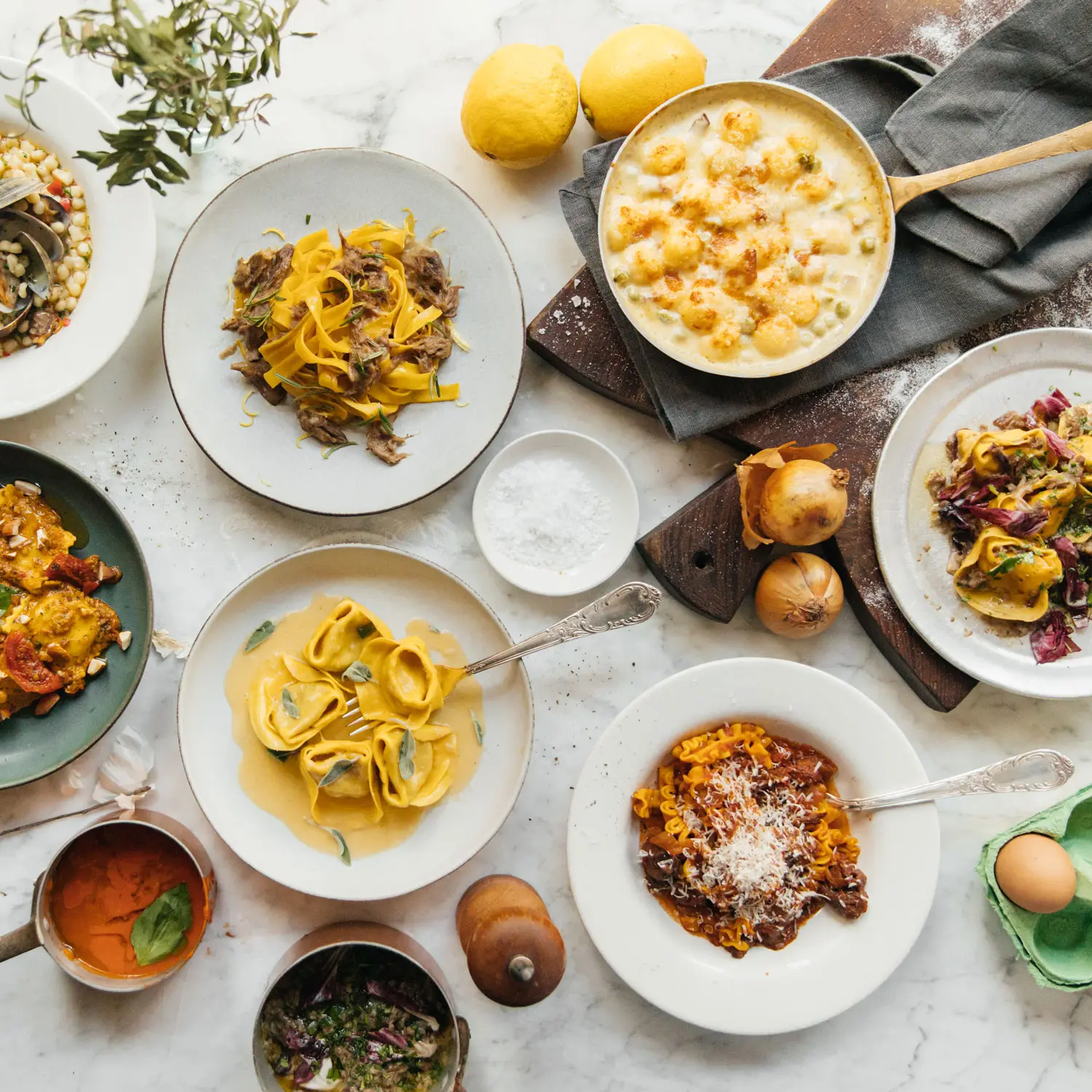
Not all pasta is made the same. From the eggs and flour that form the dough to the ingredients inside each filling and the way every shape is crafted, seemingly small choices can make a remarkable difference to the finished pasta.
At La Tua Pasta, we’ve spent over 20 years making fresh pasta with one principle at heart: quality should never be compromised for convenience or speed.
For us, luxury isn’t about extravagance. It’s about exceptional ingredients, traditional craftsmanship and taking the time to do things properly. It’s using 30% free-range eggs from our own flock instead of relying on colourings to create a rich golden dough. It’s selecting Italian 00 and durum wheat flour for the right balance of delicacy and bite. It’s slow-cooking meat for hours, choosing ingredients at their seasonal best and folding our tortelloni by hand so we can fill them generously without compromising their texture.
Some of these choices make our pasta more expensive to produce. Some make it slower to make. But each one has a purpose — whether that’s creating a silkier pasta sheet, a more generous filling, a better al dente bite or simply allowing the flavour of exceptional ingredients to speak for themselves.
So, what actually makes a pasta “luxury”? And what should you look for when choosing truly high-quality pasta?
Here’s what makes ours different.
It starts with the eggs
Eggs are one of the simplest ingredients in fresh pasta — but also one of the most important.
We have our own flock of free-range hens, giving us greater control over their diet and wellbeing. They can roam outdoors and are fed a carefully selected diet rich in corn and leafy greens, helping produce the deep golden-orange yolks that give our pasta its naturally rich colour.
We use 30% free-range eggs in our pasta, compared with the 8–14% typically used by many other pasta producers. That higher egg content doesn’t just affect the colour: it gives the pasta a richer flavour, more delicate texture and naturally higher protein content.
In fact, our plain pasta contains 17.8g of protein per 100g, compared with around 7–10.5g in many plain pastas.
The result? A naturally golden pasta with a rich flavour and delicate texture — without needing colourings to make it look the part.
Why we use two different flours
We use a carefully selected combination of Italian 00 flour and durum wheat flour because each brings something different to the pasta. Together, they give us the balance of delicacy, strength and bite we’re looking for.
Italian 00 flour is made from soft wheat and is the finest and whitest grade in the traditional Italian classification system. The “00” refers to the degree of refinement achieved through milling and sifting, resulting in an exceptionally fine, silky flour.
Its brilliant white colour also provides the perfect canvas for our deep golden egg yolks, allowing their natural colour to shine through. More importantly, its fine texture allows us to roll our pasta into thin, delicate sheets that feel silky on the palate while remaining strong enough to hold a generous filling.
Durum wheat, meanwhile, comes from a harder variety of wheat and gives the pasta structure, strength and that satisfying resistance when you bite into it. It helps our pasta hold its shape during cooking and contributes to the al dente texture associated with great Italian pasta.
By combining the two, we get the best of both: pasta that is thin and delicate enough to let the filling shine, yet strong enough to hold its shape and give you that distinctive bite.
How to spot high-quality pasta
One of the easiest places to start is the ingredients list. Great pasta doesn’t need a long one: traditionally, it should be made from just flour, eggs and a little salt.
Colour can tell you something too. Additions such as turmeric or artificial colours can be used to give pasta a more intense yellow appearance. At La Tua Pasta, we believe that colour should come naturally from the ingredients themselves — particularly the eggs.
You can also look closely at the pasta itself. Tiny dark or black specks can indicate that the flour or semolina has not been as finely refined or sifted, while a clean, even appearance can be an indication of carefully selected flour and a controlled production process.
Ultimately, what isn’t in your pasta can be just as important as what is. A short ingredient list and naturally vibrant colour are two simple things worth looking for.
Great fillings start with great ingredients
For us, creating a great filling begins long before anything reaches the pasta dough.
When choosing ingredients, we look for the right balance between local, seasonal and exceptional quality. Wherever possible, we source locally when the ingredient meets the standard we’re looking for. For ingredients intrinsically tied to a particular region or Italian culinary tradition, we go to the source, choosing Italian ingredients with DOP certification where appropriate.
Seasonality matters too. Some of our pastas are only available at certain times of the year because we’d rather use an ingredient when it is naturally at its best than compromise simply to keep a particular flavour available year-round.
But “fresh” doesn’t automatically mean better. For some ingredients, instant quick freezing can actually help us maintain greater consistency. Our Spinach & Ricotta pasta, for example, uses carefully selected spinach harvested at its peak and frozen to preserve its flavour and quality.
For us, it’s not simply about whether something is fresh, local or seasonal. It’s about choosing the best ingredient for the pasta whilst doing the best for the planet.
What goes inside matters just as much
Once we have the right ingredients, how we treat them is just as important.
Vegetables such as pumpkin and asparagus are steamed or roasted to concentrate and preserve their natural flavour before being combined with Italian cheeses such as ricotta, mozzarella and mascarpone.
For meat fillings, we take a slower approach. Premium cuts are braised and slow-cooked for up to six hours with red wine, allowing the meat to become exceptionally tender while developing deep, rich flavours.
The result is a filling that remains moist, soft and full of the flavour of its main ingredient rather than dense or overly processed. We don’t add artificial flavourings or unnecessary fillers simply to change the texture or bulk out the filling.
We believe you should be able to recognise what you’re eating. When you cut into our pasta, you should taste the pumpkin, crab, beef, truffle or cheese — not a list of ingredients designed to imitate them.
Preservatives are only present in certain individual ingredients, such as ’nduja or potato flour, where they have been added by the supplier to help maintain freshness, stability and safety.
Why we still fold our tortelloni by hand
Our tortelloni are designed around one thing: the filling.
Each piece contains around 16–17g of filling, creating the generous, indulgent bite that has become one of their defining characteristics.
That generous amount of filling is precisely why we fold our tortelloni by hand, one by one. Working with soft, delicate fillings requires a careful touch. Hand-folding allows us to pack each piece generously while keeping the filling fresh, creamy and soft.
It also means we don’t have to change the filling simply to make it easier for machinery to handle. Many machine-made filled pastas require a firmer filling, which can mean incorporating ingredients such as potato flakes or breadcrumbs to alter its consistency. By folding ours by hand, our fillings can remain naturally soft and creamy, allowing the quality and texture of the main ingredients to come through.
And despite often being called tortellini, ours are technically tortelloni. Tortellini are traditionally much smaller — historically described as being so tiny that seven could fit on a tablespoon. Tortelloni are their considerably more generous cousin.
Ours are deliberately substantial: thin pasta wrapped around plenty of filling and folded individually by hand.
Why bronze dies matter
The way pasta is shaped might seem like a small detail, but it can completely change how it behaves on the plate.
We extrude our pasta through traditional bronze dies, a process known in Italy as trafilata al bronzo. As the dough passes through the bronze, friction creates a naturally rough, slightly porous surface rather than the smooth, shiny finish often associated with pasta extruded through Teflon-coated dies.
Why does that matter? Sauce.
Those tiny ridges give sauce something to cling to, helping it coat the pasta rather than simply sliding off. Bronze extrusion also contributes to the substantial texture and satisfying bite we look for in great Italian pasta.
It’s a slower approach than some methods used in high-volume production, but for us, the eating experience is worth it.
The difference is in the eating
After all, the difference between one pasta and another isn’t something that should only exist on an ingredients list. You should be able to taste it.
It’s in the richness of the dough, the bite of the pasta, the generosity of the filling and, ultimately, how much you enjoy the dish in front of you.
That’s the standard we’ve worked towards for over 20 years — and one we’ll continue to bring to every piece of pasta we make.
